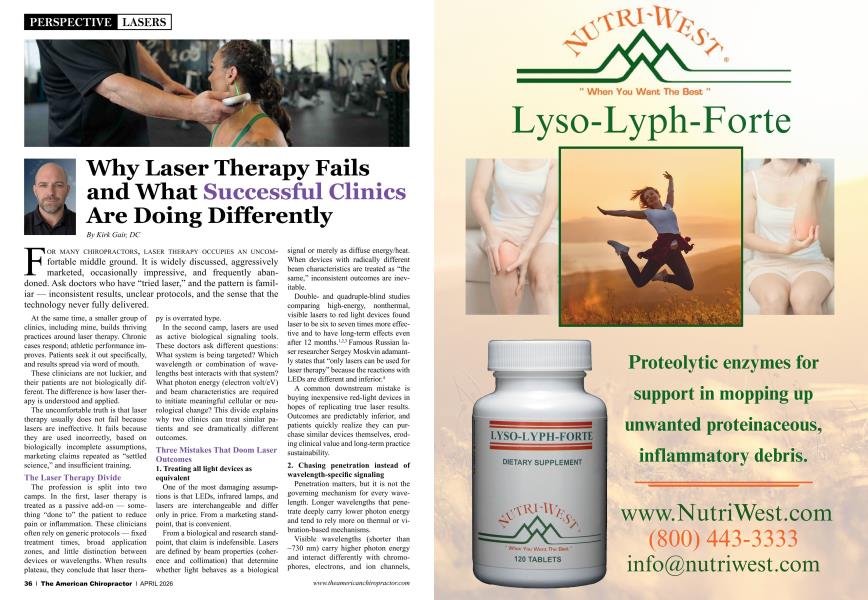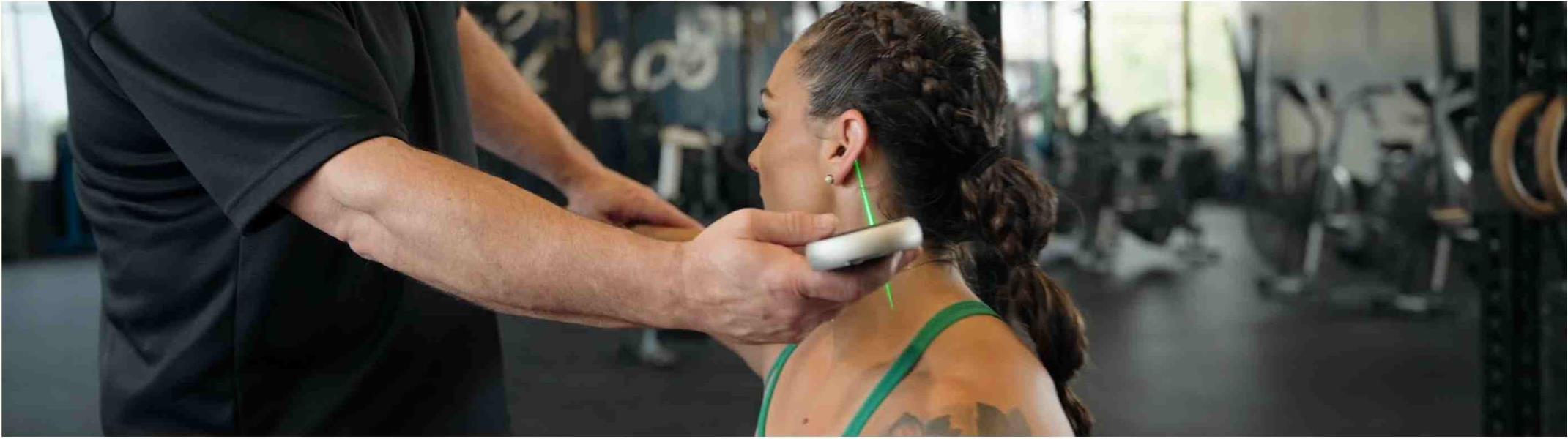
FOR MANY CHIROPRACTORS, LASER THERAPY OCCUPIES AN UNCOMfortable middle ground. It is widely discussed, aggressively marketed, occasionally impressive, and frequently abandoned. Ask doctors who have “tried laser,” and the pattern is familiar — inconsistent results, unclear protocols, and the sense that the technology never fully delivered.
At the same time, a smaller group of clinics, including mine, builds thriving practices around laser therapy. Chronic cases respond; athletic performance improves. Patients seek it out specifically, and results spread via word of mouth.
These clinicians are not luckier, and their patients are not biologically different. The difference is how laser therapy is understood and applied.
The uncomfortable truth is that laser therapy usually does not fail because lasers are ineffective. It fails because they are used incorrectly, based on biologically incomplete assumptions, marketing claims repeated as “settled science,” and insufficient training.
The profession is split into two camps. In the first, laser therapy is treated as a passive add-on — something “done to” the patient to reduce pain or inflammation. These clinicians often rely on generic protocols — fixed treatment times, broad application zones, and little distinction between devices or wavelengths. When results plateau, they conclude that laser therapy is overrated hype.
In the second camp, lasers are used as active biological signaling tools. These doctors ask different questions: What system is being targeted? Which wavelength or combination of wavelengths best interacts with that system? What photon energy (electron volt/eV) and beam characteristics are required to initiate meaningful cellular or neurological change? This divide explains why two clinics can treat similar patients and see dramatically different outcomes.
One of the most damaging assumptions is that LEDs, infrared lamps, and lasers are interchangeable and differ only in price. From a marketing standpoint, that is convenient.
From a biological and research standpoint, that claim is indefensible. Lasers are defined by beam properties (coherence and collimation) that determine whether light behaves as a biological signal or merely as diffuse energy/heat. When devices with radically different beam characteristics are treated as “the same,” inconsistent outcomes are inevitable.
Doubleand quadruple-blind studies comparing high-energy, nonthermal, visible lasers to red light devices found laser to be six to seven times more effective and to have long-term effects even after 12 months.2-3 Famous Russian laser researcher Sergey Moskvin adamantly states that “only lasers can be used for laser therapy” because the reactions with LEDs are different and inferior.4
A common downstream mistake is buying inexpensive red-light devices in hopes of replicating true laser results. Outcomes are predictably inferior, and patients quickly realize they can purchase similar devices themselves, eroding clinical value and long-term practice sustainability.
Penetration matters, but it is not the governing mechanism for every wavelength. Longer wavelengths that penetrate deeply carry lower photon energy and tend to rely more on thermal or vibration-based mechanisms.
Visible wavelengths (shorter than -730 nm) carry higher photon energy and interact differently with chromophores, electrons, and ion channels, producing photochemical and signaling effects that do not require deep penetration or high power.
Medicine already accepts this principle. UV light penetrates only microns into the skin but drives systemic vitamin D effects that impact bones in the whole body. Blue light used for neonatal jaundice alters bilirubin metabolism without direct penetration to the liver.5
For both of those cases, if you tried to produce vitamin D or impact the jaundiced baby with any other wavelength, like green, red, or infrared, you would not be able to get the same result, no matter how high you put the power (watts). That would just dose more photons with the wrong energy and wavelength for the desired result.
Furthermore, research has shown that visible lasers can impact tissue far deeper than penetration depth. Independent studies show that violet, green, and red lasers can influence extracellular-matrix-modifying enzymes relevant to disc biology and trigger repair without needing direct penetration to disc tissue.6 “Depth is everything” is a marketing idea, not a complete biological framework, and applies mostly to the low-energy IR wavelengths.
Many protocols are structured around watts and minutes rather than biology, claiming that higher power delivered faster must be better. Research has shown otherwise when objective results are measured.
Biological systems respond to optimal dosing windows, not brute force. Higher doses often produce diminished or even opposite effects compared with lower, properly timed doses. In some cases, excessive dosing produces shortterm pain inhibition while undermining longer-term outcomes because they primarily cause bioinhibition when doses are very high.7
In contrast, lower doses have a biostimulatory effect on tissues, which creates greater tissue repair. The paradox is that the very high dose can rapidly decrease pain, and when combined with the thermal impact, it can appear to be doing more than the nonthermal lower-dose device. The biggest results with low-power, high-energy devices are seen at long-term follow-up points, such as six months and 12 months.8
Key Point: Delivering the same total dose can produce different effects depending on irradiance and exposure time. Longer exposure at lower power can outperform short, high-power application for long-term results.9,10
The analogy is simple: slow cooking versus a microwave, or an IV drip versus pushing the whole bag at once. Same total dose but different results because of time. This matters even more when treating neurological tissue, particularly for pediatric patients, where overshooting the “sweet spot” can provoke unintended effects.
Far too often, struggling doctors had little to no training or training solely by a sales rep who often is not well versed in laser research. It is rare to see handson protocol training. Whatever device you use, ideally, you should get some hands-on training with an experienced doctor to enhance your skills.
Clinics that consistently succeed with laser therapy share the following common traits:
1. They measure objective outcomes. Range of motion, functional movement, VAS, and other observable markers are assessed before treatment and rechecked immediately after the first session. This anchors the visit in function — not just pain — and demonstrates value immediately.
2. They take live training or online training. I have taught courses for almost a decade, and nothing replaces what happens when I get doctors into small groups and have them work on each other. I do livestreams too, but in-person training rapidly increases skill and confidence.
3. They understand the concept of photon energy and beam quality and how unique reactions occur with each wavelength of light. Visible light lasers, particularly in the green and violet ranges, carry significantly higher photon energy than longer wavelengths, which matters because many cellular and neurological processes are energy dependent, not heat dependent.
4. They match wavelengths to biological targets. Different wavelengths interact with different chromophores, mitochondrial complexes, and ion channels. Rather than applying a single wavelength universally, they select tools based on the tissue and system involved.
5. Children with autism can have deficits at complexes one through four. Using only a red or IR laser will primarily impact complex four with little impact on one, two, or three. Violet energetically impacts complexes one and two, and green impacts complex three. Combining wavelengths provides broader support than using only one and can result in better outcomes.
6. They rely on protocols validated in placebo-controlled studies, and when using multiwavelength devices, they are all lasers and not a laser-plus-LED mix. Again, the Russians say that combo does not yield the same results as laser only.11
7. They treat laser therapy as an active intervention, not a passive modality. Protocols are adjusted to patient response; some respond better to longer exposure, others to shorter durations. Clinical judgment — not preset programs — drives great outcomes.12
The most dramatic wins occur with complex cases — athletes, chronic pain patients, and those with neurological dysregulation. When properly applied, laser therapy can influence nervous system regulation before structural change. Pain reduction becomes downstream, not the only goal. Clinics that recognize this stop asking whether lasers “reduce inflammation” and start asking how lasers recalibrate systems. This is where having the nonthermal, high-photon energy lasers truly “shine.”
Laser therapy is not failing as a modality. What fails is an outdated framework: equivalency myths, penetration obsession, and power-at-all-costs dosing. When clinicians match wavelengths to biology, respect dosing windows, get proper training, understand high-quality research versus case studies, and treat light as information — not just heat — laser therapy becomes more predictable, precise, and reproducible.
Dr. Kirk Gair has been in private practice since 1999 and using Erchonia cold lasers since 2004. He has treated elite athletes, including Super Bowl and MLB champions, as well as national record holders. His expertise in cold laser therapy and training in functional medicine and neurology attract patients from across the U.S. Dr. Gair has been featured in the documentary The Thyroid Secret and the bestselling book Hashimoto’s Protocol by Dr. Izabella Wentz, as well as on major health platforms and podcasts. To contact Dr. Gair, call (626) 922-1414, email drqair@gmail. com, or visit LaserChiropractic.net.
1. Trevor SB, Travis MS, Steve S. Two randomized, double-blind, placebo-controlled trials evaluating the efficacy of red 635nm low-level laser for the treatment of low back pain. Ortho & Rheum Open Access J. 2021 Jan 15;17(3): 555964 10.19080/OROAJ.2021.17.555964
2. Sammons T, Gair K, Silverman RG, Shanks S. Assessing the impact of high photon energy wavelengths on the treatment of chronic neck and shoulder pain. Evid Based Complement Alternat Med. 2023 Oct 4:2023:6672019. doi: 10.1155/2023/6672019. PMID: 37829623; PMCID: PMC 10567292.
3. Macias DM, Coughlin MJ, Zang K, Stevens FR, Jastifer JR, Doty JF. Low-level laser therapy at 635 nm for treatment of chronic plantar fasciitis: a placebo-controlled, randomized study. J Foot Ankle Surg. 2015 Sep-Oct;54(5):768-72. doi: 10.1053/j.jfas.2014.12.014. Epub 2015 Mar 10. PMID: 25769363.
4. Moskvin SV. Only lasers can be used for low-level laser therapy. Biomedicine (Taipei). 2017 Dec;7(4):22. doi: 10.1051/ bmdcn/2017070422. Epub 2017 Nov 13. PMID: 29130447; PMCID: PMC5682984.
5. Wu R, Wen L. Meta-analysis of the efficacy of different blue light therapy methods for neonatal j aundice. JMatern Fetal Neonatal Med. 2025 Dec;38(l):2430649. doi: 10.1080/14767058.2024.2430649. Epub 2024 Nov 25. PMID: 39586649.
6. Hwang MH, Son HG, Lee JW, Yoo CM, Shin JH, Nam HG, Lim HJ, Baek SM, Park JH, Kim JH, Choi H. Photobiomodulation of extracellular matrix enzymes in human nucleus pulposus cells as a potential treatment for intervertebral disk degeneration. Sci Rep. 2018 Aug 3;8(1): 11654. doi: 10.1038/s41598-018-30185-3. PMID: 30076336; PMCID: PMC6076240.
7. Andrade Fdo S, Clark RM, Ferreira ML. Effects of low-level laser therapy on wound healing. Rev Col Bras Cir. 2014 MarApr;41(2): 129-33. English, Portuguese, doi: 10.1590/s0100-69912014000200010. PMID: 24918727.
8. Madakadze C, Bailey S. Low-level laser treatment for lower back pain: CADTH horizon scan [Internet], Ottawa (ON): Canadian Agency for Drugs and Technologies in Health; 2023 Apr. Available from: https://www.ncbi.nlm.nih.gov/b... NBK596638/
9. Leal-Junior ECP, Hess F, Dias LB, Lino MMA, Machado CDSM, Martins PHGN, Casalechi HL, Tomazoni SS. Light transmission and thermal impact of different photobiomodulation therapy devices on the Achilles tendon of human volunteers: a comparative study. Photodiagnosis Photodvn Ther. 2025 Dec;56:105234. doi: 10.1016/j.pdpdt.2025.105234. Epub 2025 Sep 25. PMID: 41015277.
10. Hawkins DH, Abrahamse H. The role of laser fluence in cell viability, proliferation, and membrane integrity of wounded human skin fibroblasts following helium-neon laser irradiation. Lasers Surg Med. 2006 Jan;38(l):74-83. doi: 10.1002/ Ism.20271. PMID: 16444694.
11. Moskvin SV. Low-level laser therapy in Russia: history, science and practice. J Lasers Med Sci. 2017 Spring;8(2):56-65. doi: 10.15171/jlms.2017.11. Epub 2017 Mar 28. PMID: 28652897; PMCID: PMC5474383.
12. Andrade Fdo S, Clark RM, Ferreira ML. Effects of low-lev el laser therapy on wound healing. Rev Col Bras Cir. 2014 MarApr;41 (2): 129-33. English, Portuguese, doi: 10.1590/80100-69912014000200010. PMID: 24918727.