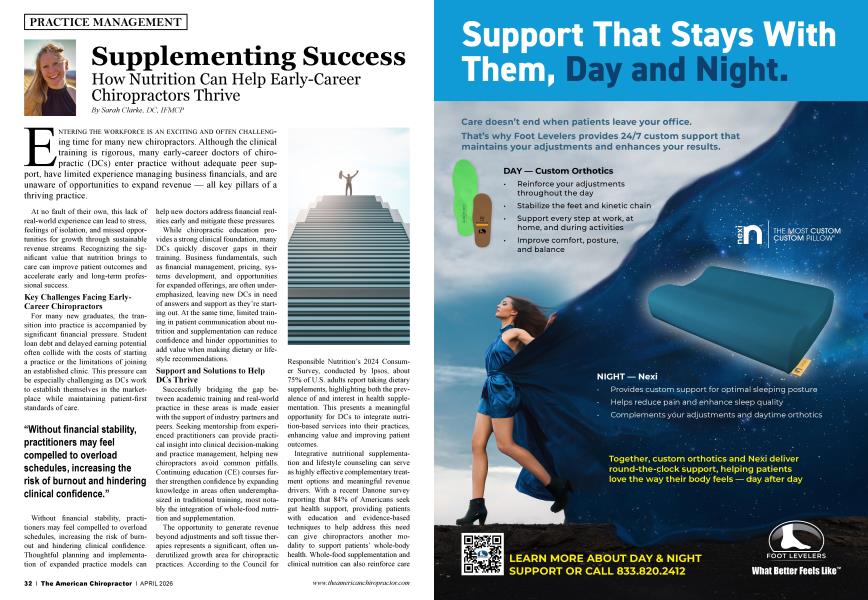
ENTERING THE WORKFORCE IS AN EXCITING AND OFTEN CHALLENGing time for many new chiropractors. Although the clinical training is rigorous, many early-career doctors of chiropractic (DCs) enter practice without adequate peer support, have limited experience managing business financials, and are unaware of opportunities to expand revenue — all key pillars of a thriving practice.
At no fault of their own, this lack of real-world experience can lead to stress, feelings of isolation, and missed opportunities for growth through sustainable revenue streams. Recognizing the significant value that nutrition brings to care can improve patient outcomes and accelerate early and long-term professional success.
For many new graduates, the transition into practice is accompanied by significant financial pressure. Student loan debt and delayed earning potential often collide with the costs of starting a practice or the limitations of joining an established clinic. This pressure can be especially challenging as DCs work to establish themselves in the marketplace while maintaining patient-first standards of care.
“Without financial stability, practitioners may feel compelled to overload schedules, increasing the risk of burnout and hindering clinical confidence.”
Without financial stability, practitioners may feel compelled to overload schedules, increasing the risk of bumout and hindering clinical confidence. Thoughtful planning and implementation of expanded practice models can help new doctors address financial realities early and mitigate these pressures.
While chiropractic education provides a strong clinical foundation, many DCs quickly discover gaps in their training. Business fundamentals, such as financial management, pricing, systems development, and opportunities for expanded offerings, are often underemphasized, leaving new DCs in need of answers and support as they’re starting out. At the same time, limited training in patient communication about nutrition and supplementation can reduce confidence and hinder opportunities to add value when making dietary or lifestyle recommendations.
Successfully bridging the gap between academic training and real-world practice in these areas is made easier with the support of industry partners and peers. Seeking mentorship from experienced practitioners can provide practical insight into clinical decision-making and practice management, helping new chiropractors avoid common pitfalls. Continuing education (CE) courses further strengthen confidence by expanding knowledge in areas often underemphasized in traditional training, most notably the integration of whole-food nutrition and supplementation.
The opportunity to generate revenue beyond adjustments and soft tissue therapies represents a significant, often underutilized growth area for chiropractic practices. According to the Council for Responsible Nutrition’s 2024 Consumer Survey, conducted by Ipsos, about 75% of U.S. adults report taking dietary supplements, highlighting both the prevalence of and interest in health supplementation. This presents a meaningful opportunity for DCs to integrate nutrition-based services into their practices, enhancing value and improving patient outcomes.
Integrative nutritional supplementation and lifestyle counseling can serve as highly effective complementary treatment options and meaningful revenue drivers. With a recent Danone survey reporting that 84% of Americans seek gut health support, providing patients with education and evidence-based techniques to help address this need can give chiropractors another modality to support patients’ whole-body health. Whole-food supplementation and clinical nutrition can also reinforce care between visits and improve health outcomes by supporting the body’s innate ability to recover.
Nutrition and supplementation are a natural extension of chiropractic care since the body’s ability to adapt and heal depends on structural alignment and foundational nutritional support. Chiropractors can utilize evidence-based protocols to serve as a blueprint for nutritional recommendations that are tailored to patients’ needs.
By educating patients about supplementation as part of their care plan, DCs can ground recommendations in science and clinical rationale, clearly explaining the importance of product quality, dosing, and duration. When delivered with transparency and a focus on proven benefit, nutrition and supplementation recommendations are perceived as supportive, value-added care that strengthens therapeutic relationships and improves long-term engagement.
By participating in nutrition educational programs through digital training, guided clinical protocols, or structured wellness plans, DCs can make supplement recommendations an actionable, scientifically backed part of their care delivery, made easier in partnership with practitioner-focused brands. Practices that deliver holistic care often stand out in competitive markets, driving patient acquisition and positive reviews as individuals experience more meaningful, measurable improvements to their health.
Building a practice that supports the doctor and patients requires more than technical skill alone; it demands a strong financial foundation, clear clinical systems, and an actionable commitment to providing whole-person care. For early-career chiropractors, incorporating whole food nutrition and supplementation offers a powerful way to improve patient outcomes while strengthening clinical credibility and practice sustainability.
New graduates don’t have to figure it out alone. With nutrition partners that specialize in DC integration, practitioners can confidently align their business strategy with patient-centered, integrative care and be positioned to thrive.

As chiropractic liaison for Standard Process, Dr. Sarah Clarke, DC, IFMCP, develops clinical protocols and continuing education for healthcare practitioners. She earned her Doctor of Chiropractic degree from Palmer College of Chiropractic West and completed evidence-based functional medicine training through the Institute for Functional Medicine. Contact [email protected] or visit www.standardprocess.com for details.
1. Munson E. CRN releases select findings from 2024 consumer survey [Internet], East Brunswick, NJ: Vitamin Retailer; 2024 November 11. Available from: https://vitaminretailer.com/cr...
2. HartDesign.com. Consumers have become much more concerned with gut health [Internet], Green Bay, WI: Hart Design and Manufacturing Co.; 2025 April 30. Available from: https://hartdesign.com/industry-news/consumers-have-become-muchmore-concerned-with-gut-health.