I AM PROUD TO ANNOUNCE THAT LIFE UNIVERSITY will be working in conjunction with Disc Centers of America (DCOA) to be the first disc-oriented clinic in the world affiliated with a university.
It is time that chiropractic and nonsurgical spinal depression (NSSD) are no longer considered alternative care. The safest route should not be an alternative. We need to educate the public on the dangers of spinal surgery and the many benefits of nonsurgical spinal decompression.
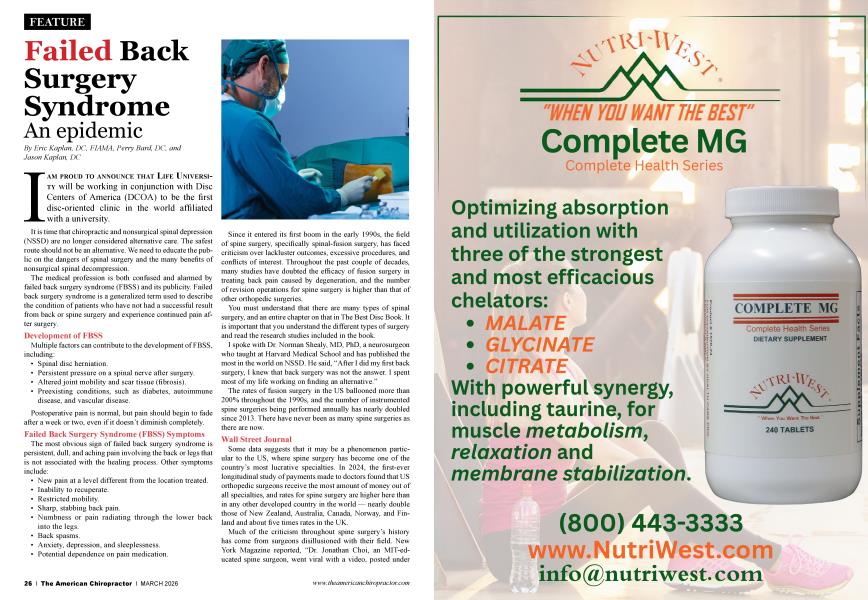
The medical profession is both confused and alarmed by failed back surgery syndrome (FBSS) and its publicity. Failed back surgery syndrome is a generalized term used to describe the condition of patients who have not had a successful result from back or spine surgery and experience continued pain after surgery.
Multiple factors can contribute to the development of FBSS, including:
• Spinal disc herniation.
• Persistent pressure on a spinal nerve after surgery.
• Altered joint mobility and scar tissue (fibrosis).
• Preexisting conditions, such as diabetes, autoimmune disease, and vascular disease.
Postoperative pain is normal, but pain should begin to fade after a week or two, even if it doesn’t diminish completely.
Failed Back Surgery Syndrome (FBSS) Symptoms
The most obvious sign of failed back surgery syndrome is persistent, dull, and aching pain involving the back or legs that is not associated with the healing process. Other symptoms include:
• New pain at a level different from the location treated.
• Inability to recuperate.
• Restricted mobility.
• Sharp, stabbing back pain.
• Numbness or pain radiating through the lower back into the legs.
• Back spasms.
• Anxiety, depression, and sleeplessness.
• Potential dependence on pain medication.
Since it entered its first boom in the early 1990s, the field of spine surgery, specifically spinal-fusion surgery, has faced criticism over lackluster outcomes, excessive procedures, and conflicts of interest. Throughout the past couple of decades, many studies have doubted the efficacy of fusion surgery in treating back pain caused by degeneration, and the number of revision operations for spine surgery is higher than that of other orthopedic surgeries.
You must understand that there are many types of spinal surgery, and an entire chapter on that in The Best Disc Book. It is important that you understand the different types of surgery and read the research studies included in the book.
I spoke with Dr. Norman Shealy, MD, PhD, a neurosurgeon who taught at Harvard Medical School and has published the most in the world on NSSD. He said, “After I did my first back surgery, I knew that back surgery was not the answer. I spent most of my life working on finding an alternative.”
The rates of fusion surgery in the US ballooned more than 200% throughout the 1990s, and the number of instrumented spine surgeries being performed annually has nearly doubled since 2013. There have never been as many spine surgeries as there are now.
Some data suggests that it may be a phenomenon particular to the US, where spine surgery has become one of the country’s most lucrative specialties. In 2024, the first-ever longitudinal study of payments made to doctors found that US orthopedic surgeons receive the most amount of money out of all specialties, and rates for spine surgery are higher here than in any other developed country in the world — nearly double those of New Zealand, Australia, Canada, Norway, and Finland and about five times rates in the UK.
Much of the criticism throughout spine surgery’s history has come from surgeons disillusioned with their field. New York Magazine reported, “Dr. Jonathan Choi, an MIT-educated spine surgeon, went viral with a video, posted under the pseudonym Dr. Goobie, in which he laid out his reasons for abruptly quitting his job and moving to the mountains. ‘I knew something was not right, right away,’ he said into the camera, standing against a picturesque rocky backdrop, swatting away mosquitoes.”
A neurosurgeon by training, Choi, like many others in the field, often performed spine surgeries, which are in much higher demand than brain surgeries. He began to notice that even if he performed a perfect surgery, its effect was variable. “Some people feel better, some people would feel the same, and some people would be worse,” he said.
He described a bad spine as a house with a leak. Water had seeped into the foundation, ruining the drywall. “The surgeries that I could do were like going into that house, tearing down the drywall, ripping out the moldy insulation, putting in brand-new insulation, and rebuilding the wall,” he said. “But not fixing the leak.”
The New York Magazine article further reported that most major surgeries present a clear etiology. An appendectomy, for instance, would most commonly be performed on patients with appendicitis, but the spine presents a kind of “choose your own adventure.”
“There’s so much ambiguity,” said Betsy Crunch, a spine surgeon better known as @ladyspinedoc to her 1.2 million Instagram followers. “A lot of it is a judgment call. You could ask five surgeons how to treat back pain, and they’ll treat it five different ways.” Along with variations in the procedures come highly specific hardware and the techniques to use them.
Eugene Carragee, the former director of the Stanford Spine Center, added, “But if you just have an aching back because of arthritis, that’s the stuff that, if it helps at all, it’s negligible or just not provable.” Complicating matters is that when it comes to the back, people often report symptoms and pain that diverge from tests and imaging. Many show signs of degeneration or injury on MRIs or X-rays without having pain or dysfunction; others who describe grueling symptoms but show mild or no imaging changes.
Then there is a more familiar complicating factor: money. Carragee was at the beginning of his tenure as the head of the Stanford Spine Center when he began to notice more of his colleagues signing corporate-consulting contracts — advising on the conception and development of new devices — sometimes worth tens of millions of dollars.
Their vacation homes, he recalled, appeared to be getting bigger and inching steadily further to the east in the Hamptons; industry trips became increasingly lavish. “It was a complete mind shift,” said Carragee, who is also the former editor-in-chief of The Spine Journal.
He recalled an early trip he was taken on by a medical-device company to Davos, Switzerland, under the auspices of discussing new research. “I pretty quickly realized I was not there to talk about the spine,” he told me. “I was there to be picked up by a black SUV and driven to some luxury resort in the mountains and drink chocolat chaud.” Throughout the 1990s, he said, the spine community went from “holding conferences where we would get together and eat deli subs to absolute bacchanals.”
Dr. Carragee’s research has been cited nearly 30,000 times, and for the most part, it scrutinizes when and how spine surgery is most effective; often, that has meant pointing out when it is not. Throughout the aughts, he published many studies that prodded the consensus that spine surgery was a primary tool in the treatment of back pain, including one that found fusion surgery didn’t help patients with ruptured disks heal faster and another arguing that for many patients, fusion surgery wasn’t helpful long term compared with other procedures.
“To a large extent, a lot of my research was just trying to figure out how valid these other, more aggressive surgeries were from a medical point of view,” he said. “Well, a lot of it was not very valid.”
The most common and most lucrative spinal procedure in the US is fusion surgery. The spinal-device market is currently valued at around $14 billion.
Between 2000 and 2019, the annual number of new spine devices more than tripled, outpacing growth in nearly all other sectors of the medical device market. Where once rods and screws dominated, now there are “shape memory” cages, 3D-printed plates, and electrical bone-growth stimulators.
Spine surgeons are divided over which devices and treatments are most effective. Carragee, though, believes fusions, in particular, have been financially exploited.
The proven-use cases for fusion “are really small, which does not make for a big money boom,” he told me. “Now, if you could expand it from people with a traumatic injury or instability syndromes to everybody with a backache, well, you’ve gone from maybe 20,000 people a year to 400,000 people a year.”
This isn’t to say that fusions are the only controversial spine procedures. The effectiveness of kyphoplasties and vertebroplasties, often used to treat fractures, has been contested as well.
In November 2024, a study conducted by the Lown Institute, a healthcare think tank, found that more than 200,000 unnecessary fusions and laminectomies (i.e., a patient’s diagnosis didn’t necessarily require surgery) were performed on Medicare patients over a recent three-year stretch. Even as insurers are increasingly stringent about surgery approval, the number and complexity of surgeries appear to be growing largely because of the ambiguity involved in treating the spine that critics say industry groups have successfully manipulated.
To New York spine surgeon Jonathan Stieber, though, the problem isn’t inherent to the industry. Bad actors, he said, have inflated rates of back surgery across the country, and research supports that belief. An update to the Lown Institute’s report, which will be published later this fall, shows that rates of spine surgery vary vastly across institutions; often, an area with extremely high rates of surgery can be traced back to one specific hospital or one specific surgeon.
Industry relationships may impact the specific implant that a surgeon uses, “like an athlete who’s sponsored by an equipment manufacturer might use a certain brand tennis racket or certain brand golf clubs.” But, he says, it is not necessarily impacting the number of surgeries they perform.
Still, others say the pressure comes from within. “You’re compensated by how much you do, and performance reviews are based on how productive you are,” said Ray, a Washington spine surgeon who has asked not to use his real name. He said he fought for years against hospital administrators who often urged him to get his numbers up (i.e., perform more surgeries).
“There’s a real push to have you be as productive as possible, to the point that my supervisor, who was the general surgeon, once came to me and said, ‘You need to be more creative with your RVUs.’ I said, ‘Can I get that in writing?”’ That pressure was part of the reason that he felt relief when he retired in 2022.
As we continue on our quest to prevent people from having surgery, I often let the patient know that surgery should be the alternative care — not chiropractic or surgical spinal decompression. The fact remains today that when people continue to experience pain in the months and years following thenprocedures, it’s known in the medical field as “failed back surgery syndrome.”
The condition doesn’t necessarily mean anything went wrong with the surgery — some people simply don’t get better. When you consider the research studies by Dr. Leslie of the Mayo Clinic, Dr. Norman Shealy, MD, PhD, or the Boxel and Martin study, the Eyerman study, and the list goes on and on.
We can continually teach at the ChiroEvent held in Jupiter, Florida. We want our doctors to master the science. Often, Dr. Deyo, from Washington State University, said maybe that the surgery itself wasn’t right for a patient, but it may also be that the surgical technique was flawed, or the hardware malfunctioned.
In the case of fusion, the surgery itself can create the conditions for failure. When speaking with Dr. Glen Zuck, an orthopedic surgeon who worked with the Philadelphia Eagles (NFL), he told me fusions often immobilize a minimum of one part of the spine, the levels below or above bear added weight, which can result in more deterioration and more pain, particularly when the joints in the spine are arthritic.
FBSS rates vary by procedure, but lumbar fusion sits at the high end with failure rates nearing 50% percent. Also, it’s been estimated that a second surgery has a 35% success rate.
Please note that Tiger Woods just had his seventh back surgery. It is not like he did not go to the best surgeons in the world.
Patients’ pain continues to be a kind of black hole for the medical industry, notoriously difficult to classify and describe. We deal with pain daily in our offices. We deal with patients looking for answers.
We think nonsurgical spinal decompression, based upon medical research, offers the safest alternative with some of the best results in the world. Dr. Bard and I have spent our lives educating the masses of our profession on nonsurgical spinal decompression.
If you’d like to learn more, you need to come to the ChiroEvent in Jupiter, Florida. We believe it’s the most comprehensive one-day seminar to educate you as a doctor — not as a salesperson. You walk away with almost 1,000 pages of notes.
We hope to see you in Florida!

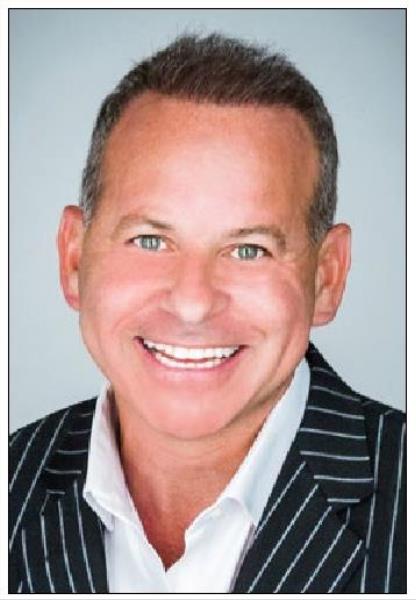
Dr. Eric Kaplan and Dr. Perry Bard, are business partners of over 32 years. They have developed Disc Centers of America & Concierge Coaches, now in the eleventh year, as well as the first and largest National Certification Program for Non-Surgical Spinal Decompression. Currently, they have over 150 clinics using their Disc Centers of America brand and lead ongoing success training events throughout the year. Formore information on coaching, spinal decompression, or seminars, visit www.TheChiroEvent.com or www.DecompressionCertified.org, or call the Chiropractic Q&A Hotline at 888-990-9660.
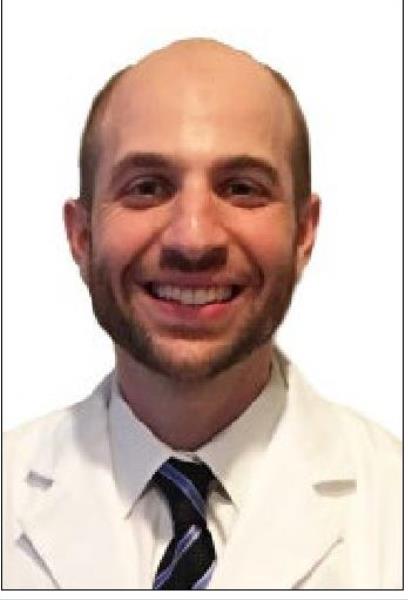
Dr. Jason Kaplan is a graduate of PARKER University. Along with his wife Dr. Stephanie Kaplan, they practice in Wellington Florida. Jason is an Instructor for Disc Centers of America. He has been recognized and honored by the International Disc Education Association and serves on the Medical Advisory Board for Non-Surgical Spinal Decompression. He teaches technique at the National Certification Program at Life University and is considered a Master on Non Surgical Spinal Decompression. www.WellinqtonDisccenter.com.