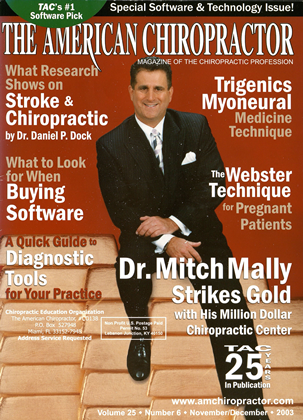
Board Certified Chiropractic Neurologist and a Board Certified Chiropractic Orthopedist Stroke & Chiropractic Adjustments When I was in chiropractic school, a teacher stated that, as chiropractic grows in popularity, we will be attacked by our competitors. Recently, chiropractic was on the receiving end in the national media with regard to the relationship of stroke and chiropractic neck adjustments, even though it is also reported so rarely that it occurs only once in forty-three chiropractic professional careers. What I do not see in the media is that the medical research documents vertebral arteries can dissect (tear) spontaneously or with simple neck movement. One can get these articles at the hospital libraries of the medical doctor that tells the patient to avoid chiropractic adjustments. In the interest of public safety, shouldn't these medical doctors inform the general public and their patients that the vertebral arteries can dissect spontaneously or with simple neck movement, not just movement of the neck in a chiropractic office? Shouldn't these medical doctors tell the general public and their patients that they should avoid all neck movement, not just the movement in a chiropractic office? Doesn't it seem that the medical doctors' public safety notices are lacking? Their alerts seem to give a false sense of security to the public and their patients. Their message seems to indicate that avoiding a chiropractor can avoid the spontaneous dissection (tear), the dissection that can occur with simple neck movement. We all know that, for the unidentifiable population at risk, this is simply not true. Some would state that it is the force of the adjustment that is the reason and cause of the vertebral artery dissection (tear). This ignores the medical research and common sense. We have all treated patients hurt in car collisions. They had their head turned to either side and the car was hit from behind. Look at the forced rotation and hyperextension that happened to your patient. But, I doubt the doctors reading this have seen a case of a dissected (torn) vertebral artery with stroke in the car collision cases they have seen. Are the medical doctors stopping the physical therapists from adjusting (mobilizing) patients? The patient most likely walked into the chiropractic office with the vertebral artery dissection—the secondary stroke occurring due to the pre-existing vertebral artery dissection, not due to the chiropractic care. Do these vertebral artery dissections (tears) and secondary strokes occur without the patient seeing a chiropractor? Of course they do and there are medical articles to show this. Yet, if the same person did see a chiropractor, would the chiropractor get blamed as the cause? Of course they would. E7T3 Dr. Daniel P. Dock is a Board Certified Chiropractic Neurologist and a Board Certified Chiropractic Orthopedist. He has written four books: A False Claim: Stroke From Manipulation, Whiplash Trauma, Records Documentation, and The Orthopedic Spinal Examination. The recipient of the Minnesota Chiropractic Association-President's Award, Washington State Chiropractic Association s Volunteer of the Year Award. Georgia Chiropractic Association's Honorary Life Time Membership, Dr Dock lectures at over 60 continuing education seminars per year. He also maintains an active practice in Minnesota. For more about Dr. Dock e-mail daasia.ckdc.cjam.. TV Network Focuses on Chiropractic Link to Stroke On November 6, ACA learned that WNBC-TV in New York City was planningto aira news segment that afternoon, on chiropractic and the risk of stroke, and that it could be syndicated nationwide the next morning. Reporter David Marks, MD, of WNBC-TV, an NBC affiliate, alerted ACA that he planned on airing his story at 5 PM. Thestory has been sent to local NBC affiliates across the country, which means the story could possibly air in your local television market in the nearfuture. Because of the sensitive nature of this issue, ACA is urging doctors to use the talking points and links belowto help respond toquestionsfrom concerned patients orthe media on this topic. ACA President Donald J. Krippendorf, DC, had been in close communication with Dr. Marksdur-ingthe weeks leadinguptothe broadcast urging him to interview Dr. Scott Haldeman and Dr. Rand Swenson, well-known authorities on the topic of chiropracticandstroke. However, Marksdedined, saying he had already completed the interviews forhissegment ACA staff also provided Marks with well-documented information on the extremely small risks of chiropractic cervical manipulation a nd ACA's response to a May 13 study in the journal Neurology. Marksconcededthatthe risks of chiropracticareveryminute, but said that the focus of his story would probably be on the issue of informed consent Should this newssegmentairinyourlocalcom-munity, or if you need additional information, please contact ACA's Communications Department at 800-9864636. For information on the following topics, refer to the links provided. Talking points on the issue of chiroprac tic cervical manipulation, informed con sent and the low risk of treatment. <h_ttn;//w.wwJacatoday,conj/p(lf/ informed_consent_bullets.pdf> A document by William J. Lauretti, DC, titled, "What Are the Risks of Chiroprac tic Neck Adjustments,"_<http;// www.acatoday.com/pdf/chitOr risks.pdf> ACA's response to the study that was published in the May 13,2003, issue of the journal Neurology. <http;// www.acatoday.com/media/reLeases/ Q51203,sntml> Anyone with questions or who needs additional information should contact ACA at 800-986-4636.